This grow lights guide is your complete resource for understanding light spectrums, plant stages, and how to choose the right grow light for your setup.
This grow lights guide is the most practical resource you’ll find for understanding light spectrums and plant stages. Choosing the right grow light is one of the most consequential decisions you’ll make for your indoor garden. Get it right and your plants will reward you with fast, healthy growth, strong flowering, and impressive yields. Get it wrong — the wrong spectrum, insufficient intensity, or inefficient technology — and even the best nutrients and growing technique won’t compensate. This guide covers everything you need to understand to make that decision well.
Grow Lights Guide: Understanding Light Spectrums and Plant Growth
This grow lights guide light spectrums plant stages is your complete resource for indoor growing success. Plants use light for photosynthesis across a specific range of wavelengths: 400–700 nanometres, known as Photosynthetically Active Radiation (PAR). Within that range, the colour of light — its wavelength — has a significant influence on how plants grow and develop.
- Blue light (400–500nm): Promotes compact, bushy vegetative growth. Plants under blue-heavy light develop shorter internodes, thicker stems, and larger leaf area. This is why blue-spectrum fluorescents and LEDs work so well for propagation and seedling stages.
- Red light (600–700nm): Triggers and supports flowering and fruiting. Red wavelengths activate the phytochrome system that regulates the plant’s transition from vegetative to reproductive growth. HPS lamps are red-heavy, which is why they’ve been the traditional flowering light for decades.
- Far-red light (700–750nm): Extends the red range and works synergistically with red to improve the Emerson effect — accelerating photosynthesis beyond what either wavelength achieves alone. Modern full-spectrum LEDs include far-red for this reason.
- Green light (500–600nm): Penetrates deeper into the canopy than red or blue, contributing to photosynthesis in lower leaves. Contrary to older thinking, plants do use green light — full-spectrum output including green improves overall canopy efficiency.
PAR, PPFD and DLI — The Numbers That Actually Matter
Watts is not a useful measure of grow light effectiveness. What matters is how much usable light actually reaches your plants. The relevant metrics are:
- PAR (Photosynthetically Active Radiation): The range of light wavelengths plants use (400–700nm) — the category, not a number
- PPFD (Photosynthetic Photon Flux Density): The intensity of PAR light measured at the canopy surface, in µmol/m²/s (micromoles of photons per square metre per second). This is the key number for assessing light intensity
- DLI (Daily Light Integral): Total light delivered over a 24-hour period, calculated as PPFD × photoperiod hours × 0.0036. This is the total photosynthetic dose your plants receive each day
- Efficacy (µmol/J): How efficiently a light converts electrical power into usable PAR — the key metric for running cost comparison between technologies
Target PPFD ranges by growth stage:
- Propagation / seedlings: 100–300 µmol/m²/s
- Vegetative growth: 400–600 µmol/m²/s
- Flowering: 600–1,000 µmol/m²/s
- High-intensity specialist grows: 1,000–1,500 µmol/m²/s (with CO2 supplementation)
Types of Grow Light — Which Technology Is Right for You?
LED Grow Lights
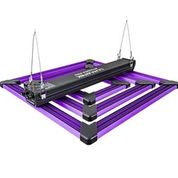
Modern LED grow lights — particularly quantum board-style LEDs — are now the dominant choice for indoor growing, and for good reason. Top-tier LEDs from brands like Lumatek, Gavita, Sanlight, and Maxibright achieve efficacy ratings of 2.5–3.0+ µmol/J, meaning they deliver more usable PAR per watt than any other technology. They also run cooler, reducing heat management requirements in the grow space.
Full-spectrum LEDs cover the entire PAR range from blue through red and far-red, making them effective at every growth stage with a single light. Many models include dimming capability — useful for managing heat, adjusting light intensity for different growth stages, or running at partial power in smaller spaces.
Best for: All growers, all growth stages, particularly those prioritising running cost efficiency and heat management.
HPS (High Pressure Sodium)
HPS remains a proven flowering technology. The red-heavy spectrum triggers and maintains flowering exceptionally well, and the heat output — often cited as a disadvantage — can actually be an asset in cooler climates or winter grows where maintaining room temperature is a challenge. 600W HPS remains one of the most cost-effective options per gram of yield for growers not concerned about running costs.
The main disadvantages of HPS are heat output (requiring extraction management), lower efficacy compared to modern LEDs, and the need for bulb replacement every 1–2 grows as output degrades.
Best for: Experienced growers in cooler rooms, budget-conscious setups, or growers already established with HPS infrastructure.
CMH / CDM (Ceramic Metal Halide)
CMH and CDM lights offer a broad, white-light spectrum closer to natural sunlight than HPS. The CRI (colour rendering index) is significantly higher, and the UV output from CMH has been shown to improve essential oil and terpene production. 315W CMH is a popular choice for smaller tents where its balanced spectrum and manageable heat output make it well suited for full-cycle grows.
Best for: Single-light full-cycle grows, growers prioritising quality of yield, or those wanting a step up from fluorescents without committing to high-power HID.
Propagation Lighting
For propagation, seedlings, and mother plants, high-intensity LEDs or fluorescent T5 panels provide the right level of low-intensity, blue-rich light. Dedicated propagation lights prevent the light stress that young seedlings experience under full-power flowering lights, and their low heat output makes them easy to position close to the canopy without burning.
How to Choose the Right Light for Your Space
A practical starting point is working backwards from your tent or room size to the light coverage area specified by the manufacturer, then cross-referencing against PPFD targets for your chosen growth stage.
General coverage guidelines (at standard hanging height):
- 0.6m × 0.6m tent: 100–200W LED or a 250W HPS equivalent
- 0.8m × 0.8m tent: 200–300W LED or 400W HPS
- 1.0m × 1.0m to 1.2m × 1.2m: 400–600W LED or 600W HPS
- 1.5m × 1.5m: 600–800W LED or dual 600W HPS
- 2.4m × 1.2m or 2.4m × 2.4m: Multiple fixture LED systems — Gavita, Lumatek, or Maxibright bar-style lights work very well in these configurations
Always check the manufacturer’s actual PPFD map rather than relying on coverage area claims alone. A PPFD map shows light distribution across the footprint at a specific hanging height — this tells you far more about real-world performance than wattage equivalency claims.
Light Schedules by Growth Stage
- Propagation / seedlings: 18–20 hours light / 4–6 hours dark
- Vegetative growth: 18 hours light / 6 hours dark (standard) — some growers use 20/4 for faster growth
- Flowering (photoperiod plants): 12 hours light / 12 hours dark — maintained until harvest
- Autoflowering varieties: 18–20 hours light throughout — autos don’t require a light change to flower
Managing Heat From Grow Lights
All grow lights generate heat — even the most efficient LEDs convert a portion of their energy input to heat rather than light. Managing that heat is essential for maintaining the temperature range plants need (typically 20–28°C at canopy level) and for preventing equipment from overheating.
Key heat management strategies:
- Choose LEDs with passive or active cooling systems appropriate for the tent size
- Size your extraction fan to handle the heat load of your lights — a good rule of thumb is to have 20–30% more extraction capacity than you think you need
- Use a fan speed controller to reduce noise while maintaining adequate airflow at cooler temperatures
- Position your intake low and exhaust high to maximise the natural movement of warm air upward
Frequently Asked Questions
Your grow light is powerful enough if it delivers 600–1,000 µmol/m²/s PPFD at canopy height during flowering, or 400–600 µmol/m²/s during vegetative growth. Use a PAR meter or check the manufacturer’s PPFD maps. Pale green new growth, yellowing, and slow development are the clearest signs of insufficient light intensity.
No — a quality full-spectrum LED performs well at every growth stage and is the most practical choice for a single-tent setup. Some commercial growers use blue-heavy lights for veg and switch to HPS or red-heavy LEDs for flower, but for most indoor growers this extra complexity delivers only marginal gains.
Both produce excellent flowering results at equivalent PPFD levels. LEDs cost less to run, produce less heat, and suit warm rooms or summer growing best. HPS costs less upfront, is simpler to set up, and has decades of proven results. For long-term economics and heat management, LED wins; for lower initial outlay and simplicity, HPS is still a solid choice.
Always follow your specific light manufacturer’s guidelines — hanging distance varies significantly by model and power. As a general guide, high-power LEDs (600W+) typically hang 40–60cm above the canopy; lower-power and propagation LEDs sit 15–30cm closer. Too close causes light stress and bleaching; too far reduces intensity unnecessarily.
We stock a comprehensive range of professional grow lights including Lumatek, Gavita, Sanlight, Maxibright, and more. Browse our full grow lights range online, or contact our team for a recommendation based on your tent size and growing goals.
For official horticultural guidance and growing tips, the Royal Horticultural Society (RHS) is an excellent resource for gardeners and indoor growers.
Further Reading
- Do LED Grow Lights Really Work?
- The Benefits of LED Grow Lights
- The Complete UK Grow Tent Guide (grow light sizing context)
Shop the Products in This Guide
Browse by category: Adjust a Wing reflectors, CFL Lights, Daylight Grow Lights, Digital Ballasts, Gavita Grow Lights, Grow Light Reflectors.
Shop featured products: ADJUST-A- WINGS ENFORCER SMALL REFLECTOR AND LAMPHOLDER, ADJUST-A-WINGS 315W E40 3K LAMP, ADJUST-A-WINGS SPREADER LARGE, ADJUST-A-WINGS SPREADER MEDIUM.